One of My Dogs Attacked the Other and Hurt Her Will She Do It Again
Why would dogs fight with a familiar canis familiaris living in the same dwelling house? 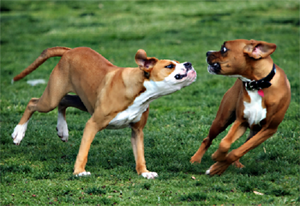
Dogs are social animals whose evolutionary history makes them willing and able to live in groups. Group living enabled the dog's ancestors, wolves, to work together to obtain nutrient, raise their immature, and defend their territory. Much of a dog'due south communication with other members of its species is past subtle, energy-conserving body language and concrete displays.
"It would be counter-productive for members of a group to fight with each other and risk injury."
It would exist counter-productive for members of a group to fight with each other and adventure injury. More often than not, well-nigh well socialized dogs strive to avoid concrete or aggressive confrontation. Nonetheless, these dogs may be living in close proximity to each other with limited opportunities to avoid confrontations or placed in frequent competitions over desirable resource, resting places or human interactions. Dogs that are not well socialized or have deficits either in their ability to translate or communicate with other dogs are more than predisposed to aggressive confrontations. Like people, non all dogs are natural or skilled communicators with members of their own species.
What is a dominance bureaucracy, and does this explain why dogs may fight?
Previously, about familiar dog-dog interactions were described as a dominance bureaucracy in which one dog was competing to take over by controlling resources such as food, space, and favored possessions. Current interpretations of canine behavior question these underlying motivations as an accurate estimation of how dogs contemplate these confrontations. Dogs indeed show a preference slope and a variable desire for certain resources and their power to retain or secure these may be predicted based on ascertainment of by experiences and confrontations. These resources include nutrient, resting places, mates, territory and favored possessions. Ability to acquire these resource is mostly communicated through facial expressions, body postures, and actions. The more confident, bold, believing dog may deem his chances good against a meeker, less confident and less successful opponent. Fighting is rare, since as soon equally one dog submits or defers, the bolder brute gets its way, he or she gives up the challenge. These displays may appear non-existent in some households while in others, these displays are dramatic and may seem to support a clear hierarchy. The apparent winner of these confrontations may change depending on health, previous experience and relative motivation to get or maintain a resource (i.e., who wants it more). While advice of intention and submission are not in dispute, the premise that a linear hierarchy exists and dogs are intent upon successfully taking over the pack is in slap-up dispute. Observations of wild wolf packs advise non a hierarchal struggle but that wolves collaborate as human parents with their children by caring for them, leading when appropriate, teaching when advisable and so the immature leave the pack to start their ain families. Even so, our family dogs are not related and exercise not have the opportunity to leave a social grouping that is not socially a good fit for them. This can consequence in ongoing social stress and misunderstandings and perhaps aggressive encounters between dogs (see Potency, Blastoff, and Pack Leadership – What Does It Actually Mean? and Canine Communication – Interpreting Dog Linguistic communication).
My dogs have lived together for some time and now they are fighting. Why?
Fighting between dogs within a household can have several underlying motivations:
i. Fights may occur when a younger, larger, more agile dog challenges an older, confident dog in an attempt to change the existing pattern of resource partition. This is most likely to arise every bit the younger dog grows and matures or equally the older dog ages or becomes more than infirm. If the older domestic dog acquiesces, things volition be fine; still, if the older dog does non relinquish resources, fighting can persist. In addition, owners may non want the change and will intervene, which creates anxiety, may exacerbate the fighting and may inadvertently back up and encourage the dog that is more suited to a deferential human relationship.
two. A change in the household, routine, or family may lead to altered responses between the pets. This may result from underlying anxiety in 1 or both of the pets or an inability to adjust the change. In addition, once assailment arises between dogs, regardless of cause, the learning that has occurred may then affect further interactions between the dogs.
3. Fighting of a younger dog toward a canis familiaris that is aging or sick may be a function of the disability of the older dog to respond with advisable postures and signaling when interacting with the younger dog. This may lead to a change in their predictable relationship. If a pet's responses, including assailment are due to an underlying disease process, the medical factors will need to first be addressed if a harmonious human relationship is to be reestablished. Unfortunately many medical problems, especially those associated with aging, might not be able to be entirely resolved; in these cases, prevention rather than improvement might be all that can be expected. For instance, dogs with medical conditions that lead to pain and irritability may become increasingly more than aggressive when approached or handled. Dogs with cognitive dysfunction, sensory decline or disorders affecting mobility, might no longer be able to communicate effectively with other dogs both in the brandish of signals too is in reading the signaling of others (through facial expressions, torso postures and deportment). While some dogs are quite tolerant and readily conform to the changes in the way that the older (or ill) pet responses, many dogs become more than anxious and unable to cope with the altered behavior of the older pet (run across Senior Pet Behavior Bug and Senior Pet Cerebral Dysfunction).
four. When the social group changes such as the confident, assertive dog leaves or a new dog enters the dwelling house, the existing dogs try to restructure and predict their new social relationships. This tin besides occur betwixt dogs raised together as they reach social maturity and endeavour to restructure their relationship.
v. In some cases, aggression between the dogs may be redirected (i.e., when i or both dogs become highly aroused by an effect or stimulus unrelated to the other dog, e.thou., mail carrier's inflow, owner's difference, owner'southward homecoming), it may straight its aggression toward the other dog because it is nearby or accessible.
six. Fights tin can also occur due to underlying anxiety such as separation feet or racket sensitivities. If this is the case, unless the underlying disorder is identified and treated fighting may not resolve.
vii. Fights are most probable to occur over admission to resources that are considered important to ane domestic dog more than the other (resource-holding potential) (see Aggression – Possessive – Objects and Toys and Aggression – Possessive – Food Basin). These might include nutrient, resting places, territory, favored possessions or social interactions with the owners or another dog in the home. These fights occur most ofttimes between dogs of near equal ability and motivation and often, merely non e'er, dogs of the aforementioned sex activity, and seem to be most astringent between female person dogs. High states of arousal and resources that are particularly appealing or novel may increase the chances of aggression. Fighting would most likely ascend if both dogs have a loftier desire for the same resource, if the desire to retain the resources is stronger in the more than subordinate dog (especially if he or she gets to the resource first), or if the possessor supports the dog that is being challenged.
viii. With age and maturity, some dogs with formerly harmonious relationships begin to display posturing and behavior that is inappropriate in a social context. In some cases it might be that the previously subordinate dog fights dorsum in situations where it previously displayed appeasing and deferential posturing. Conversely, dog A, the more than confident dog, may keep to set on, despite appropriate subordinate signaling from its housemate. On the other hand, canis familiaris A may not brandish any preliminary posturing (growl, snarl, stiffening) when challenged but gain direct to a full-out attack. In both scenarios, canis familiaris A is behaving inappropriately. These cases can be diagnostic dilemmas because allowing the pets to piece of work things out or only supporting the natural development of their human relationship might lead to serious injury. In a free living situation these dogs would not go along to co-habitate, instead they would dissever themselves sufficiently to avert ongoing ambitious confrontation. People are rightly concerned when their dogs exercise not go along with each other merely in reality nosotros should be duly impressed anytime our random selection of canine personalities actually do mesh harmoniously.
9. It is probable and advantageous that dogs in a household would use canine communication and posturing to avoid aggressive interactions so that the fights would be mild and inhibited. Therefore, when there is fighting between dogs in a home, it is more than likely to be caused by conflict over resources, fear, pain and irritability, redirected aggression, or sociopathic tendencies (in which i or more of the dogs have underdeveloped or bereft social advice skills). In some cases, one of the dogs is behaving abnormally and a beliefs consultation with a veterinary behaviorist is necessary to decide which dog is behaving most abnormally and the diagnosis, prognosis and whether medication may be needed.
How do I notice out why my dogs have been fighting?
Because the aggression could exist due to normal learned challenges, medical problems, owner responses, excessive feet, poor social communication skills or peradventure a lack of impulse control, a total behavioral workup is advised.
"However, the most important diagnostic tool in any behavioral case is often the history you provide."
This would start with a physical exam including a neurological assessment, diagnostic tests to rule out medical issues, and possibly treatment trials to try to resolve the health bug and control the signs. Yet, the nearly important diagnostic tool in any behavioral example is often the history y'all provide. In add-on, to the general information on the family, the household, your schedule and previous training, the specifics of the problem itself from the time it began to the present twenty-four hour period is critical. A videotape can also help us to diagnose what is happening between the pets (see Diagnosing a Behavior Problem – Is It Medical or Behavioral? and Aggression – Introduction).
Both my dogs are the same historic period, and after a third, older dog died, they began to fight. Why?
Conflicts may occur between dogs when the human relationship is ambiguous or when they have like motivations and by experiences of success. Afterwards the decline, affliction or death of an older dog, fighting may begin in the remaining dogs even when i is clearly the most confident and believing. This is considering the older dog may have helped to maintain a stable relationship amid all dogs and now they are trying to constitute relationship patterns. In whatever example, the fighting tin can be astringent and injurious. It is too possible that thechange to the household and relationship dynamics may atomic number 82 to increased anxiety in the household. Although you should generally attempt to allow dogs to resolve their differences on their ain if they are just threatening without fighting, you will demand to intervene if there is the potential for injury. Under no circumstances should the dogs be allowed to "fight information technology out." You could be injured due to redirected ambitious attacks, or when you endeavor to break upwards the fight (see below).
Both my dogs are the same age, and after a third, older domestic dog died, they began to fight. Why?
Conflicts may occur between dogs when the dominance status is cryptic or when they are particularly close in rank. Later on the decline, illness or death of an older dog, fighting may brainstorm in the remaining dogs even when one is clearly ascendant. This is because the older dog may have helped to maintain a stable relationship amongst all dogs and at present they are trying to constitute new positions. In whatsoever case, the fighting can exist severe and injurious. It is also possible that the change to the household and pack leads to increased anxiety in the household. Although you should generally attempt to allow dogs to resolve their differences on their own if they are simply threatening without fighting, yous will need to intervene if there is the potential for injury. Under no circumstances should the dogs be allowed to "fight information technology out". You could be injured due to redirected aggressive attacks, or when you endeavor to suspension up the fight (see beneath).
My younger dog always deferred to the older dog, simply now they fight. Why is this happening? 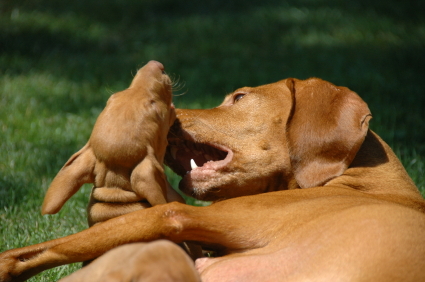
One scenario that can result in social aggression is when an older, previously bold, confident, and believing dog, is challenged past a younger, more aggressive dog. This may happen every bit the older dog ages, or every bit the younger canis familiaris reaches behavioral maturity at 12 to 36 months. This may be an attempt to alter the existing hierarchy. Sometimes the older dog will accede and things are fine, but at other times the owners practise non want the change and volition intervene. In some situations, the older dog may not be willing to defer even though information technology cannot physically compete with the younger domestic dog. This can result in severe, injurious fights. Commonly, it would be advisable to support the older dog and discourage the younger dog's challenges. However, if change is inevitable so information technology may become necessary to cease the support of the older domestic dog, and to discourage attempts to fight back. Notwithstanding, if the young domestic dog does not stop its assertive and distance increasing displays as presently every bit the older dog shows deference or appeasing postures, and then it must be controlled and inhibited. Some younger dogs are bullies and do not recognize deference or give any dogs inside the household; these dogs should not exist supported equally the leader dog. (For treatment run across Aggression – Sibling Rivalry – Treatment).
travisstemblitrand46.blogspot.com
Source: https://vcahospitals.com/know-your-pet/dog-behavior-problems-aggression-sibling-rivalry-diagnosis
0 Response to "One of My Dogs Attacked the Other and Hurt Her Will She Do It Again"
Post a Comment